 Honolulu City Tours
Chinatown Honolulu: What to See
Last reviewed August 2026
Chinatown Honolulu what to see comes down to a handful of walkable blocks: a historic district old enough to be one of the oldest Chinatowns in the United States, two produce-and-food markets, an art gallery strip, and a stretch of Maunakea Street selling some of the cheapest fresh leis on Oahu. It sits at the western edge of downtown, a short walk or an even shorter Red trolley ride from Iolani Palace and the rest of the civic core covered in our downtown walking guide. This breaks the neighborhood down block by block, with an honest read on its evening character and a realistic morning timeline for covering it.
Quick answer
Chinatown Honolulu is worth a half-day: a historic district of early-1900s buildings around the Hawaii Theater and the Wo Fat Building, two produce-and-food markets, an independent art gallery scene, and Maunakea Street's lei shops, all within the same walkable blocks at downtown's western edge. It's one of the oldest Chinatowns in the United States, and the honest read on its evening character is worth knowing before booking a visit around dinner or nightlife.
Key takeaways
- Maunakea Street is the lei-shopping corridor, fresh leis start around $3 to $6 depending on the flowers
- The Hawaii Theater, opened in 1922 and once called "The Pride of the Pacific," anchors the historic district
- Two markets, Oahu Market and Maunakea Marketplace, cover fresh produce, meat, seafood and a multi-cuisine food court under one roof
- First Friday, the first Friday of every month, turns the same streets into an arts-and-bars crawl after dark
- It's a short walk from downtown's civic sights, and the Red trolley line stops right in the neighborhood
- None of the tours on this site route through Chinatown itself, this is a self-guided add-on to a downtown morning
Chinatown at a Glance
What's where, in one table
Chinatown packs a historic district, two markets and a gallery scene into a few walkable blocks bordered by North Beretania and Nu'uanu Street, stretching toward the harbor.
| Block or spot | What it is | Best for |
|---|---|---|
| Maunakea Street | The lei-shopping corridor, plus the Maunakea Marketplace food court | Fresh leis and a quick, cheap multi-cuisine lunch |
| Hawaii Theater and the Arts District | 1922 theater anchoring a strip of galleries on Bethel and No'eau Streets | Architecture, live shows, browsing local art |
| Historic Wo Fat Building | One of Chinatown's oldest and most photographed buildings | A quick photo stop mid-walk |
| Oahu Market | Open-air produce, meat and seafood stalls | A look at how the neighborhood actually shops |
| Kuan Yin Temple | A small, quiet temple a few blocks north | A calmer stop away from the market crowds |
The Historic District
One of the oldest Chinatowns in the United States
Chinatown Honolulu grew out of the mid-1800s, when Chinese laborers who'd finished their sugar plantation contracts settled near the harbor and opened shops and small businesses, making it one of the oldest Chinatowns in the country. Much of what stands today dates from a rebuild starting in 1901, after a Board of Health fire meant to contain a Bubonic Plague outbreak burned out of control on January 20, 1900, spreading for 17 days and destroying 38 acres and roughly 4,000 homes, leaving over 7,000 people without one.
The Hawaii Theater and the Wo Fat Building
The Hawaii Theater opened in 1922 and was known in its day as "The Pride of the Pacific," hosting everything from vaudeville and silent films to orchestras, and it still runs live shows today, with the lit-up marquee sign a common photo stop even for visitors not catching a performance. A short walk away, the historic Wo Fat Building is one of Chinatown's oldest and most photographed structures, long associated with one of the neighborhood's original restaurants.
Markets and Lei Shops
Two markets, two different personalities
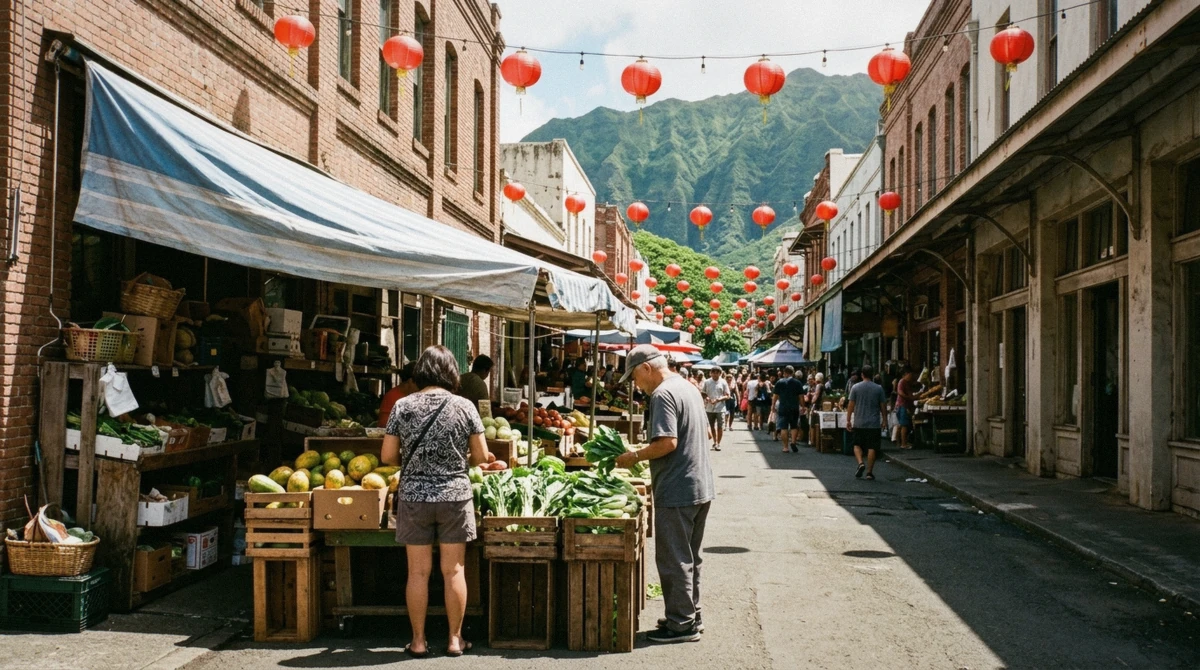
Oahu Market is the open-air original: produce stands, fresh fish and meat counters, and vendors who've worked the same stalls for years. Maunakea Marketplace, a short walk away, pairs a similar mix of produce and inexpensive souvenirs with a food court running Chinese, Vietnamese, Thai, Korean and Filipino stalls side by side, the easiest single stop in Chinatown for a cheap, varied lunch.
| Market | What's there | Best for |
|---|---|---|
| Oahu Market | Open-air produce, fresh fish and meat stalls | Seeing how the neighborhood actually shops |
| Maunakea Marketplace | Produce, inexpensive souvenirs, and a multi-cuisine food court | A cheap, varied lunch stop |
Maunakea Street's lei corridor
Maunakea Street is where Chinatown's lei shops cluster, and it's genuinely one of the cheaper places on Oahu to buy one: fresh leis start around $6 depending on the flowers, and a day-old lei can run closer to $3. The leis are handmade on site, and shops will often take a request for specific flowers or colors rather than just selling what's already strung.
Art Galleries and First Friday
A gallery strip built out of Chinatown's old storefronts
The Chinatown Arts District, centered on Bethel and No'eau Streets, has turned a run of the neighborhood's older, once-neglected storefronts into galleries and boutique studios showing local artists, with the Hawaii Theater serving as the district's architectural anchor.
First Friday changes the whole neighborhood after dark
On the first Friday of every month, First Friday turns the same blocks into a walkable arts-and-nightlife event: galleries and shops stay open late, some offer discounts, and there's live music and street performance mixed in with the regular restaurant and bar crowd. It's grown more into a bar-hopping night out than a purely gallery-focused event over the years, worth knowing going in if a quiet gallery stroll is the goal rather than a busier night out.
Food Halls and a Quick Bite
Where to eat without picking a single restaurant
Maunakea Marketplace's food court is the fastest way to sample Chinatown's range in one stop, Chinese, Vietnamese, Thai, Korean and Filipino stalls all under the same roof. The Chinatown Cultural Plaza offers a more contemporary version of the same idea, with dim sum counters, noodle houses and seafood restaurants arranged around an outdoor courtyard, plus souvenir and accessory shops around the edges.
Is Chinatown Honolulu Safe to Visit?
An honest, practical read
Chinatown carries a long-standing reputation on Oahu for being one of the rougher neighborhoods, and locals who've spent years living and working there generally describe that reputation as outdated more than accurate today. During the day, the streets are busy with shoppers, market vendors and people on their way to work, the same practical awareness that makes sense in any dense city market applies here: keep bags close, use common sense about which streets look active versus empty, and travel in a group after dark if visiting for the nightlife or First Friday rather than wandering solo late at night.
A Morning in Chinatown
A realistic order for covering the core blocks on foot, starting at the markets and finishing near the arts district.
-
9:00 AM
Oahu Market
Start at the open-air market while the produce and seafood stalls are freshest and least crowded.
-
9:30 AM
Maunakea Street lei shops
Browse the lei corridor; if a lei is part of the plan for later in the day, buying fresh in the morning beats a wilted one by evening.
-
10:15 AM
Maunakea Marketplace
A food court break here doubles as a look at the multi-cuisine stalls even for visitors not ready to eat yet.
-
11:00 AM
Historic Wo Fat Building and Hawaii Theater
A short walk toward the theater district, the natural photo-stop stretch of the morning.
-
11:30 AM
Chinatown Arts District
Galleries on Bethel and No'eau Streets close out the walk; check ahead if First Friday timing lines up with the trip.
-
12:00 PM
Kuan Yin Temple (optional extension)
A few blocks further north for a quieter close to the morning, away from the market crowds.
Getting to Chinatown and Pairing It with the Rest of Your Trip
From Waikiki or downtown
Chinatown sits at downtown's western edge, so anyone already covering Iolani Palace and the rest of the civic core can simply keep walking; the Red trolley line also stops in the neighborhood for visitors who'd rather ride than walk the full loop from Waikiki.
No site tour routes through here
None of the guided city tours of Honolulu rated here route through Chinatown, the Pearl Harbor tour heads west to the memorial and the scenic half-day loop covers island lookouts rather than the historic district. For Chinatown specifically, the choice is this self-guided walk or the Red trolley line, easiest paired with a downtown morning before or after a separate guided tour elsewhere on the island.
Market Visit Checklist
Before heading in
- Bring cash, small vendors and lei stalls on Maunakea Street work best with bills, not cards
- Budget roughly $3 to $6 per fresh lei, cheaper than most places on Oahu according to local guides
- Head to the Maunakea Marketplace food court for a mixed Chinese, Vietnamese, Thai and Filipino lineup under one roof
- Keep bags zipped and close, Chinatown draws the same petty-theft risk as any dense city market
- Time it to the first Friday of the month for First Friday, when the same blocks turn into an arts-and-bars crawl after dark
Chinatown rewards a slow morning more than a checklist approach, there's no single ticketed attraction pulling the pace along, just markets, galleries and a genuine 19th-century streetscape to wander through block by block. Pair it with the rest of the downtown walk for a full morning, or treat it as its own short trip, either way it's one of the more distinct neighborhoods a Honolulu itinerary can cover on foot.
Timing is the quiet variable in all of this. The markets are a morning organism: stalls are fullest and coolest before eleven, the lunch counters hit their stride at noon, and by mid-afternoon the produce crates are being broken down while the galleries stay open into the evening. If your Honolulu schedule pairs Chinatown with the downtown walk, do Chinatown first and let the civic blocks fill the hotter hours, when shade from the government buildings and the banyan trees counts for more than awnings do.
On a first visit, an hour and a half covers the core blocks without rushing; add another hour if the food halls are part of the plan.
Questions About Chinatown Honolulu
Is Chinatown in Honolulu worth visiting?
Yes. It's one of the oldest Chinatowns in the United States, with a historic district around the 1922 Hawaii Theater, two markets, an independent art gallery scene and Maunakea Street's lei shops, all within a few walkable blocks at downtown's western edge.
What are some fun things to do in Chinatown, Honolulu?
Browse the lei shops on Maunakea Street, eat through the Maunakea Marketplace food court, walk the Chinatown Arts District's galleries on Bethel and No'eau Streets, and time a visit to First Friday, the first Friday of the month, if an arts-and-bars evening fits the trip.
What is the best thing to do in Chinatown?
The lei shops on Maunakea Street are Chinatown's signature stop, fresh leis from around $6, cheaper than almost anywhere else on Oahu, and handmade on site. Pairing that with a stop at the Hawaii Theater and the Wo Fat Building covers the historic core in the same walk.
What to do in Chinatown during the day?
Daytime is when the markets are at their best, Oahu Market and Maunakea Marketplace are both busiest and freshest in the morning, and it's the easier time to browse the Arts District's galleries, most of which keep standard daytime hours outside of First Friday evenings.
Is Chinatown Honolulu safe?
Chinatown carries an older reputation for being one of Oahu's rougher neighborhoods, one that locals who work and live there generally describe as outdated. Daytime visits are busy and low-key, the same common-sense precautions that apply to any dense city market, close bags, aware of surroundings, apply here too, especially after dark.
Does the Waikiki Trolley go to Chinatown?
Yes, the Red trolley line stops in the neighborhood on its historic downtown route, an easy way to reach Chinatown without driving or parking.