 Honolulu City Tours
Things to See in Downtown Honolulu
Last reviewed August 2026
The things to see in downtown Honolulu sit about 15 to 20 minutes from Waikiki by car or trolley, packed tight: the only royal palace on US soil, a national cemetery inside a volcanic crater, and Hawaii's one-time tallest building into an area small enough to cover on foot in a morning. This guide walks through the seven sights worth building that morning around, in the order a self-guided route naturally puts them, and explains where the Waikiki Trolley's Red line does and doesn't overlap with the walk.
Quick answer
Downtown Honolulu is worth a half-day: Iolani Palace, the King Kamehameha I statue, Chinatown, Aloha Tower and Punchbowl National Memorial Cemetery all sit within walking distance of each other in the civic core. It's genuinely walkable on flat streets, and the Red trolley line covers most of the same route on a 60-minute schedule if walking the whole loop isn't the plan.
Key takeaways
- Iolani Palace is the only royal palace on US soil, built in 1882, the anchor of any downtown walk
- The King Kamehameha I statue gets draped in lei around June 11 each year for Kamehameha Day
- Punchbowl, the National Memorial Cemetery of the Pacific, sits inside Pūowaina, a volcanic crater above the city
- Honolulu Hale hosts Honolulu City Lights every December, if a visit lines up with the holidays
- The Red trolley line runs the same historic core every 60 minutes for travelers who'd rather ride than walk the whole loop
- None of the tours listed on the homepage route through downtown, this walk (or the Red line) is the way to see it
Is Downtown Honolulu Worth Visiting?
Yes, and it's flat enough to walk
Downtown Honolulu is the civic and historic core of the city, distinct from both Waikiki's beachfront strip and Ala Moana's shopping center, and it holds a concentration of real history, a royal palace, a 19th-century church, a national cemetery, that neither of those neighborhoods has. The streets are flat and laid out on a grid, which makes it one of the more genuinely walkable pockets of Oahu; comfortable shoes and a few hours cover the core sights without needing a car for the day.
How it differs from a Waikiki day
Waikiki is beach, shopping and resort towers; downtown is government buildings, a 140-year-old palace, and narrow Chinatown streets. Visitors expecting a beach extension of Waikiki are usually surprised by how civic and historic downtown actually feels, closer to a compact old city center than a resort district. That contrast is exactly why it's worth the short trip: it's the one part of central Honolulu that isn't built around tourism first.
Downtown Honolulu at a Glance
Seven sights, one compact core
Every sight below sits within the same walkable civic district, and most are on or within a block of the Red trolley line's route.
| Sight | What it is | On the Red trolley line? |
|---|---|---|
| Iolani Palace | The only royal palace on US soil, built 1882 for King Kalākaua | Yes |
| King Kamehameha I statue | Bronze statue fronting Aliʻiōlani Hale, lei-draped around June 11 | Yes |
| Aliʻiōlani Hale | Historic government building behind the Kamehameha statue | Yes |
| Kawaiahaʻo Church | 19th-century coral-block church, a classic downtown walk stop | Yes |
| Chinatown | Historic district of shops, markets and lei stands | Nearby, short walk from the route |
| Aloha Tower | 1926 waterfront landmark, once Hawaii's tallest building | Nearby, short walk from the route |
| Punchbowl National Memorial Cemetery | National Memorial Cemetery of the Pacific, inside Pūowaina crater | Yes |
Civic and Royal Landmarks
Iolani Palace
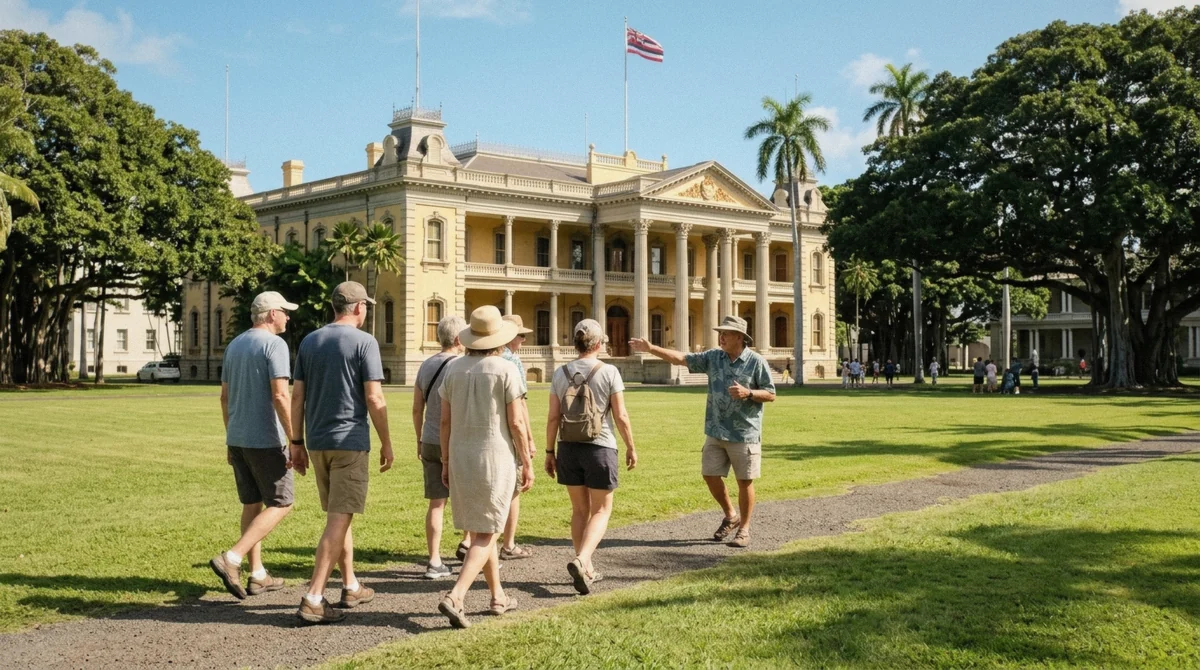
Built in 1882 for King Kalākaua, Iolani Palace is the only royal palace on US soil, and it anchors the entire downtown district both physically and historically. It sits at the center of the civic core, within a short walk of the Kamehameha statue, Aliʻiōlani Hale and the state capitol grounds, the natural first stop on any downtown route, whether on foot or via the Red trolley line.
King Kamehameha I statue
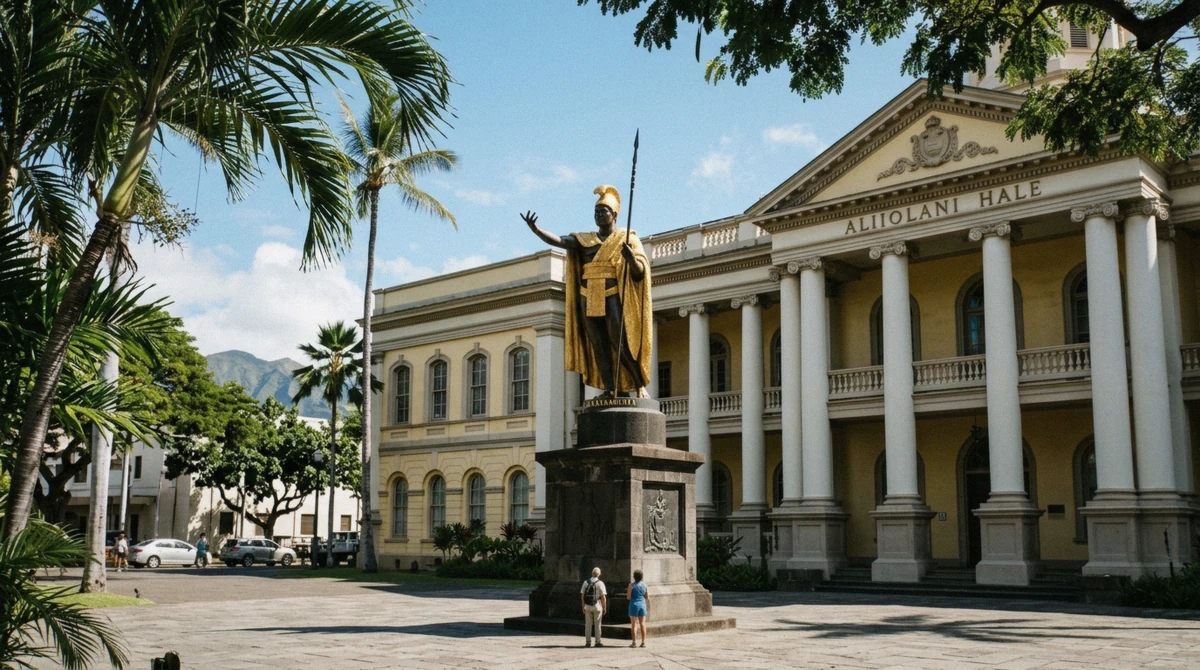
The bronze statue fronting Aliʻiōlani Hale honors King Kamehameha I, who unified the Hawaiian Islands, and it's one of the most photographed spots in downtown Honolulu. Around June 11 each year, for Kamehameha Day, a state holiday, the statue is draped in lei, a detail worth timing a visit around if the date lines up with a trip, and one that turns an ordinary photo stop into a genuinely local moment.
Aliʻiōlani Hale
The government building standing behind the Kamehameha statue, Aliʻiōlani Hale is a fixture of the same civic block and part of the visual backdrop for most Kamehameha statue photos, even for visitors who don't step inside.
Kawaiahaʻo Church
A short walk from the palace grounds, Kawaiahaʻo Church is one of the classic stops on a downtown walk, alongside Chinatown, a 19th-century coral-block building that's stayed part of the standard downtown route for as long as guidebooks have covered the area.
Chinatown and the Waterfront
Chinatown
Downtown's historic Chinatown district sits a short walk from the palace grounds and is a standard stop on any downtown Honolulu itinerary, with shops, markets and lei stands lining its streets. It's the part of the walk with the most street-level browsing, a change of pace from the civic buildings a block or two away.
Aloha Tower
Built in 1926, Aloha Tower was once the tallest building in Hawaii, standing over the harbor as the first landmark generations of arriving ships saw before the airport era changed how visitors reached the islands. It's a short walk from Chinatown toward the waterfront and worth the detour for the harbor view alone, even for visitors who don't go up the tower itself.
Honolulu Hale and Honolulu City Lights
The city hall that becomes a holiday landmark
Honolulu Hale is the city's own city hall, part of the same civic cluster as the palace and Aliʻiōlani Hale. Every December, it hosts Honolulu City Lights, the city's holiday display, worth knowing about even outside the holiday season, since the building itself is on most downtown routes year-round regardless of the time of year a visit falls.
Punchbowl: National Memorial Cemetery of the Pacific
Inside a volcanic crater above the city
Punchbowl, formally the National Memorial Cemetery of the Pacific, sits inside Pūowaina, a volcanic crater set back from the rest of the downtown core, on higher ground with views over the city below. It's a quieter, more solemn stop than the palace or Chinatown, and it draws visitors on a different kind of trip than a shopping or sightseeing morning, a place to walk slowly rather than check off quickly. It's reachable on the Red trolley line along with the rest of the civic-core stops.
Getting There from Waikiki
About 15 to 20 minutes, several ways to cover it
Downtown Honolulu sits roughly 15 to 20 minutes from Waikiki by car or trolley, close enough that it doesn't need to eat a whole day even with the walking loop included. A rideshare or taxi is the fastest door-to-door option and the simplest for a single morning trip. Driving works too, though downtown parking is limited around the palace and civic buildings and fills up on weekday mornings when government offices are in session, a metered street spot or a nearby parking structure are the realistic options, and neither is guaranteed to be close to the first stop on the walk.
The trolley as the no-parking option
For visitors who'd rather not deal with downtown parking at all, the Red trolley line solves that problem directly: it boards from Waikiki, runs the same historic core this guide covers, and needs no parking search on either end. It's the natural pairing for anyone without a rental car, or anyone who'd simply rather not spend part of the morning circling for a spot.
A Self-Guided Downtown Morning
A realistic order for covering the core sights on foot, starting from the palace grounds and finishing near the waterfront.
-
9:00 AM
Iolani Palace grounds
Start at the palace itself, the natural anchor point and the closest stop to the Kamehameha statue and Aliʻiōlani Hale.
-
9:30 AM
King Kamehameha I statue and Aliʻiōlani Hale
A short walk from the palace; check the date against June 11 for the lei-draped version of the statue.
-
10:00 AM
Kawaiahaʻo Church
A brief stop on the walk toward Chinatown, one of the classic downtown route landmarks.
-
10:30 AM
Chinatown
Slower browsing pace among the shops, markets and lei stands; the natural place to take a longer break.
-
11:15 AM
Aloha Tower
A short walk toward the waterfront to close the loop with a harbor view at the site of Hawaii's one-time tallest building.
-
12:00 PM
Punchbowl (optional extension)
Set apart from the rest of the route and reached by a longer walk or a short ride; plan this as a separate leg rather than an add-on to an already full morning.
How the Red Trolley Line Covers This Route
Riding instead of walking
For travelers who'd rather ride than walk the full loop, or who want to add downtown onto a day that also includes Diamond Head or Ala Moana, the Waikiki Trolley's Red line runs through the same historic core, Iolani Palace, the Kamehameha statue's block and Punchbowl among its stops, on a 60-minute frequency. The full trolley breakdown covers what a pass costs and how the Red line's schedule compares with own-pace walking; because the Red line only comes by once an hour, treating each stop as a planned block of time works better here than trying to hop quickly between them.
| Option | Pace | Covers |
|---|---|---|
| Walking this route | Self-paced, roughly 3 hours for the core loop | All seven sights, including Chinatown's street-level browsing |
| Red trolley line | Fixed 60-minute frequency between stops | Iolani Palace, the Kamehameha statue block and Punchbowl; Chinatown and Aloha Tower are a short walk from the nearest stop |
No site tour routes through downtown
None of the guided Honolulu tours compared side by side on this site actually route through downtown, the Pearl Harbor tour heads west to the memorial, and the scenic half-day loop covers island lookouts rather than the civic core. For downtown specifically, the choice is between this self-guided walk and the Red trolley line, not a guided city tour. Travelers pairing a downtown morning with an afternoon elsewhere on the island might reasonably follow it with the Pearl Harbor tour or check whether a guided tour is worth it for the rest of the trip.
Downtown Honolulu rewards a slower morning more than most Oahu stops do, there's no ticketed attraction pulling the pace along, just a walkable grid of real history between a 19th-century church, a working city hall, and a volcanic crater holding a national cemetery. Whether that morning happens on foot or on the Red trolley line, it's worth treating as its own destination rather than a quick pass-through on the way somewhere else.
Questions About Downtown Honolulu
Is downtown Honolulu worth visiting?
Yes, it holds the only royal palace on US soil, a 19th-century church, Chinatown, a former tallest-building-in-Hawaii landmark, and a national cemetery inside a volcanic crater, all within a walkable civic core about 15 to 20 minutes from Waikiki.
Is downtown Honolulu walkable?
Yes, the streets are flat and laid out on a grid, and the core sights (Iolani Palace, the Kamehameha statue, Kawaiahaʻo Church, Chinatown, Aloha Tower) sit within a comfortable walking loop of each other. Punchbowl sits apart and is better treated as a separate leg.
What is there to do in downtown Honolulu besides Waikiki and Ala Moana?
Downtown is Honolulu's civic and historic core: Iolani Palace, the King Kamehameha I statue, Aliʻiōlani Hale, Kawaiahaʻo Church, Chinatown's shops and markets, the waterfront at Aloha Tower, and Punchbowl National Memorial Cemetery above the city, a different experience from both the beachfront and the mall.
What shouldn't I miss in downtown Honolulu?
Iolani Palace is the anchor, the only royal palace on US soil, and worth building the rest of a downtown morning around. Chinatown and Punchbowl are the two stops most different in character from the rest of the walk, worth including if time allows for both.
Does the Waikiki Trolley go to downtown Honolulu?
Yes, the Red line runs through the historic downtown core, including Iolani Palace and Punchbowl, every 60 minutes. The full trolley breakdown covers pricing and how it compares to walking the route.
When is the best time to see the King Kamehameha statue?
Any day of the year works for a look at the statue itself, but around June 11, for Kamehameha Day, it's draped in lei, a detail worth timing a downtown visit around if the date works with a trip.